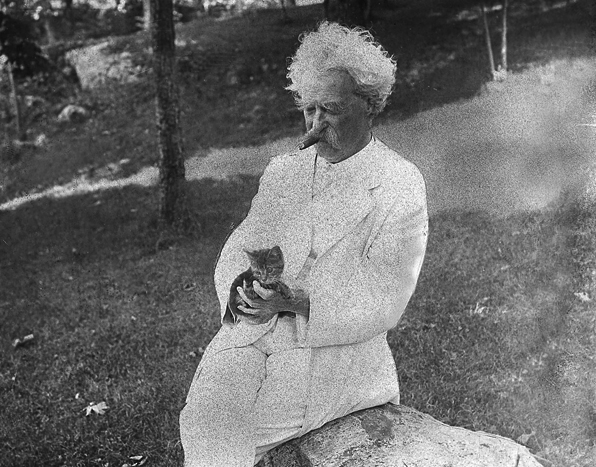
Mark Twain and his cat
Image

Writers and cats

I’ve noticed something about writers. We tend to love cats.

That’s not to say there aren’t dog-loving scribes out there; surely there are. But there seems to be a disproportionate number of us who love cats.

Every now and then, Buzzfeed posts a vapid clickbait article about famous writers and their cats. And I admit that one of my guilty pleasures is reading such things. But even in my own network of writers I follow on Twitter, I’ve noticed a lot of cat love. Urban fantasy writer Seanan McGuire often posts tales and pics of her cats. Sci-fi scribe John Scalzi is also a cat lover. Neil Gaiman is also a big cat fan, frequently writing about cats in his novels with a certain level of admiration. One of his favorite quotes of mine:

“‘No,’ said the cat. ‘Now, you people have names. That’s because you don’t know who you are. We know who we are, so we don’t need names.’”
—Neil Gaiman, Coraline

Is there something about this mysterious, aloof creatures that we writers have an affinity with? Do we look into those slitted eyes and see something that sparks creativity, or do we just enjoy having an animal around that doesn’t require much maintenance?

One of life’s great mysteries.

Reader on train - by Bonnie Natko
Image

Writers should ride public transit

Anyone who knows me knows that I don’t drive. I’ve got nothing personal against cars. I just feel that driving isn’t for me. Although I do make use of Uber/Lyft services to get around Los Angeles in a pinch, most of the time I just ride a bus or a train. I’ve made this work for years with minimal hassle (contrary to popular belief, LA does have a wide range of public transit options if you know how to use them and aren’t in a hurry).

There are many reasons why I ride buses and trains. It’s more economical, better for the environment, and it contributes to my nearly stress-free life. But, as a writer, there are a couple of bigger reasons why I prefer to let someone else do the driving.

The first one is a big one: since I’m not driving I can spend the whole trip reading. This is a huge benefit for me since on any given day I have about a dozen different things to do and finding reading time can be tough. Good writers must be good readers and, although I prefer to get cozy with a book in the comfort of my home, if I’m looking for a new book to read I often read the sample chapters on the bus via my Kindle app. Bus rides can take a while (especially in LA traffic), so it’s an excellent and productive use of my time.

The second reason I think writers in particular should use public transit is this: people watching.

The public transit systems of America’s big cities are like a mish-mash of all sorts of people. Here in LA, I’ve ridden the bus through Beverly Hills with rich housewives carrying their newly purchased Prada bags, and on the very same bus there’s a guy who washes dishes at a local restaurant who just ended his shift. The bus patrons here come in all shapes, ages, races, orientations, and religions. As the bus rolls through each of LA’s many varied neighborhoods, the demographics of the riders shifts accordingly. From the shiny happy people riding to the sun and sand of Santa Monica, to the dirty and desperate dudes in downtown, you’ll see every kind of flavor that LA has to offer. And each person has their own little story. Sometimes I strike up a casual chat with folks, but most of the time I just listen and watch. For a writer, this environment is like a gold mine full of fat shiny nuggets you don’t even have to dig for.

Writing good stories requires an intimate understanding of people, and not just one type of person. A writer’s stories must be filled with rich characters with rich histories and personalities. The best research environment for this, in my opinion, is a city bus on an ordinary day. A bus ride brings the world to you, as you roll down city streets and people from all walks of life hop on, sit down, and become passive passengers on a metal behemoth barreling through the urban landscape.

Now, inevitably when I mention my bus-riding ways someone will bring up their distaste of potentially having to ride with one or more homeless people. I totally understand that. I’ve never had any serious issues with transients on transit, but there have been numerous instances where they created an inconvenience. It’s unpleasant, sure. But it’s life. It’s reality. And these people, living on the lowest rung of the social ladder, can give you a hard and honest view of the world as it is, not as we wish it to be. That is also an asset for us writers. We use lies to tell the truth, we use facts to enhance fiction, and we can’t do that completely unless we expose ourselves to the unpleasant parts of life, even if it’s just a little bit.

So if you’re a writer, or an aspiring writer, I think you should catch the bus sometime. One way or another, it’ll be an experience.


Image

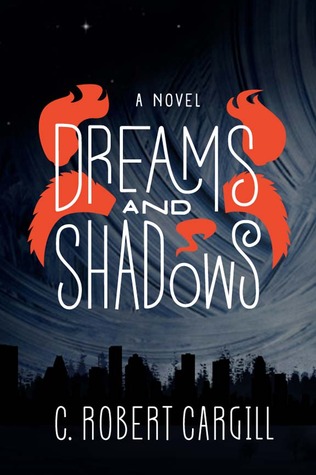
Book Review: Dreams and Shadows

I love modern fairy tales. I love them so much I’ve even started writing my own (check out my novel Clockworkers). Dreams and Shadows was like something I’d written myself, which is perhaps why I enjoyed it so much.

The novel tells the story of Ewan and Colby; two little boys who have very different upbringings but end up having the same experiences with fairy folk. But these aren’t the friendly, pretty fairies of Disney tales. These are the dangerous sprites, redcaps, goblins, and other supernatural beings who exist in a magical world just outside of ours.

It’s a dark story, for sure. The book is mostly about the unfortunate and tragic events that occur when the fairy world and the human world meet. There are lots of deaths, and Ewan and Colby end up seeing far more tragedy than 8-year-olds should ever know. But there’s also the wonderful innocence and naivete of youth that keeps the story from being wholly depressing. Ewan and Colby are often saved by the fact that they don’t know they should be scared. Author C. Robert Cargill really captures the pure, unbridled power of the imagination that little boys have. There’s a beautiful line near the beginning of the book that sums it up well:

“There is no place in the universe quite like the mind of an eight-year-old boy. Describing a boy at play to someone who has never been a little boy at play is nigh impossible.”

And our plucky young leads, combined with the carefully-crafted magical worlds they find themselves in really make the first half of the novel quite enjoyable. But when Ewan Colby grow up, I felt the book lost some of its magic. Suddenly the joys of youth were replaced by the doldrums and depression of adulthood. This is a great thematic element of the story, as it reflects how the things we learn as we mature take much magic out of the world, but it also makes the story less fun.

Still, Dreams and Shadows is a fun read with lots of interesting mythical lore based on age-old tales, combined with a modern setting and modern sensibilities. Definitely worth a read if you like your fairy tales dark and melancholy, mixed with some childish glee.

Image

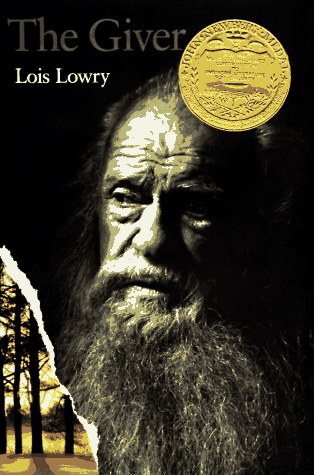
Book Review: The Giver

The Giver is one of those books I really, really should have read a long time but never got around to it. When it was released in 1993 I was already a teenager and there was no way in hell my school district was going to put it on the reading list so, unlike many fans of the work, I wasn’t aware of the story as a child. But it’s never too late to read a classic, and I have to say I enjoyed the book even though I’m far beyond the age of the target audience.

The book exposes us to the future world of Jonas, a soon-to-be twelve-year-old boy in a community that seems perfect at first. Everyone gets along. There are no wars, no crime, no fights, no unemployment. Everyone is fed, children have loving homes, and the elderly are respected and taken care of. But it all comes at a terrible cost, as the “Sameness” that brought this peace also drains the community of what we consider the joys of life, and love.

I won’t call this a dystopian novel, because the world it portrays isn’t necessarily a horrible one. It’s just very different. Jonas is not genetically related to his parents and sister; he was given to his parents after he was birthed by a designated birth mother, as all children in the Community are. His parents don’t even have sex. No one in the Community does. It is a culture marked by sterilization and predictability. But, initially, this doesn’t seem particularly insidious. There are actually some ideas that seem great on the surface. Family units (that’s actually what they’re called) in the community talk about their feelings to each other. It creates an environment where things are shared openly. Young children in the Community wear jackets that button up in the back so that others must help them dress; this creates a sense of community interdependence, which isn’t necessarily a bad thing. It’s only when you learn that these things are required by the powers that be, and adherence to The Rules is closely monitored, that these ideas become dark and foreboding. You can easily see how these concepts might have started with the best intentions but evolved into a system that snuffed out personal freedom. But, for the most part, the people in the community live safely and soundly, and since we’re not given a complete view of the world outside, it’s hard to say that The Community setup wasn’t borne out of necessity in a world that was going mad.

The other element that adds a sense of wrongness to the world is the concept of “release” from the community, which usually happens when people reach advanced age, but rarely is used as punishment and even more rarely used when infants don’t develop as healthy as The Community dictates is required. For the sake of a spoiler-free review, I won’t go into detail here. But when reading the book, I think most adult readers could easily come to a conclusion about what was really going on. There are no real plot twists in this book, but if you read it as a kid you might have been surprised, just as Jonas was. And that’s the beauty of the book, really; the end of childish naivete through knowledge. This theme kicks into full gear when Jonas meets The Giver, the only caretaker of memories from the past world, before The Community system whitewashed everything in the pursuit of perfection.

Still, the young age of the protagonist was a key factor in what made the story’s themes so powerful. Jonas just turned 12, yet The Community deems that to be the age where all citizens enter adulthood and assigned the careers they’ll have for the rest of their lives. This concept works because on one hand, it does make a bit of sense, but on the other hand it completely disregards the maturation process between the teenage years and adulthood. It’s a concept that seems alien and wrong, but for The Community it is normalcy.

That’s why I was disappointed to learn that the upcoming movie version of The Giver increased the ages of Jonas and his friends from 11/12, to 16. There’s a world of difference between those pre-teen years and mid-teens, and it seems like the entire tone of the story would change and lose much of its magic. But I will refrain from judging until the movie comes out, and with Oscar award winning cast members like Meryl Streep and Jeff Bridges there’s a chance the movie will still be good (although the movie also has Taylor Swift cast, which should be…interesting).

I’m sure there will soon be much media attention given to this story because of the film, but I encourage everyone to read the book first (and it’s a short, easy read). The Giver is a well-crafted book that took a bold approach of introducing difficult and challenging societal concepts to kids. It’s the kind of thought-provoking modern literature that teaches lessons relevant to today’s world. It’s meant for kids, but adults can certainly get something out of it as well.

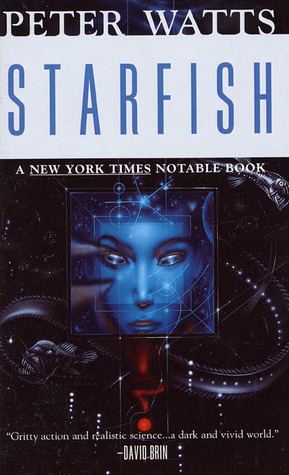
Starfish Novel Cover
Image

Book Review: Starfish by Peter Watts

If you like your sci-fi hard and your main characters psychologically disturbed, this is the book for you. Peter Watts takes a mission on the floor of the ocean and turns it into a crucible where some mad beings are formed. But, as Dickinson once said, much madness is divinest sense. The crazies aboard deep-sea station Beebe are smarter than their masters on the surface think they are, and they uncover a government plot with mistakes that would be comical if the circumstances weren’t so dire.

The first thing that struck me about this story is how detailed the science is. Peter Watts went through a lot of effort to recruit the help of scientists and military experts to get all the details as close to right as possible. Much of the science is speculative (and still is 14 years after the book was first published) but it’s all based on actual research and Watts is nice enough to include the names of the journals he referenced in the acknowledgments.

But what drives this story isn’t the science, nor the events, nor the odd setting of the bottom of the Pacific, where bioluminescent creatures roam with giant scary fish. The real engine of this story is the cast of characters, each with their own flavor of psychosis and history of abuse. The rigors of life on the deep-sea station Beebe would drive you mad, so it helps if you were already pretty crazy when you got there.

The first three quarters of the novel were riveting, but the ending leaves you hanging. That’s not a major issue since this is the first of a series, but if you like your stories to have endings with everything neatly tied up, or you don’t have the patience to read the whole series, the ending might disappoint. But if you’re looking for a different kind of sci-fi series with absolutely fascinating characters, Starfish is a good place to start.

Buy Starfish by Peter Watts on Amazon