Clockworkers: Excerpt 1

My new novel Clockworkers is coming out soon!

Here’s the plot in a nutshell: an entrepreneurial young woman inherits a special gift from her father – an elf. She puts him to work building products for her luxury watch company, but she soon discovers that there are certain dangers involved with employing elves.

Here’s a sample:


Sam Chablon, a prudent but insatiably curious man, walked gingerly across the frozen glade. It was just before sunrise, the blue hour, and the only sounds in the forest were the whispers of the wind.

Sam was stalking his latest prey. He had waited for three nights to catch even a glimpse of it, but this morning his patience had paid off. He saw the little fellow dance into a cave on the north shore of the lake.

He continued his approach at a painfully slow pace. Each step took an eternity. He was careful not to let even a single blade of grass betray his presence. He barely breathed, and he willed his excited body to stay cool, lest his quarry catch a whiff of his sweat.

He finally reached the entrance to the cave and a sweet, warm wind caressed his face, melting the ice crystals on the scraggly beard that had grown during his stay in these woods. There was a faint light in there — a white-green glow that made the rocky walls of the cave shine. With the care of a barefooted man walking on eggshells, he went inside.

The cave was deep, and its ceiling was low for a man of Sam’s height. His middle-aged knees protested when he was forced to stoop down as he tiptoed further into the cavern. But the pain was worth it. This kind of opportunity rarely happens twice.

Sam went deeper still, until the odor of the outside world was erased by a bittersweet perfume of jasmine and thyme and other fragrances he wished he knew the names of. The ghostly greenish light that he had seen earlier was now much brighter. The source was just around the bend. Sam paused. He held his breath, and carefully peered past the corner.

His eyes fell on the one thing he had searched for since his childhood: the final proof that validated years of foraging, travel, and the eccentric research that had left him ostracized and ridiculed. There, in that cave, was his dream.

An elf.

Origin story

I’m continuing along with the sci-fi novella. Here’s a little side story on its origins. It’s actually based on the first original novel I ever attempted. But it was definitely a “practice” novel (which I believe is very important for an author just starting out). The resulting story just…wasn’t very good. But I learned a lot, shelved that book, and went on to write 3 other novels that were light years beyond that first practice attempt. Still, there were some good ideas there; I just wasn’t a good enough writer to execute those ideas. Now, years later, I think I have the skills to pull a good story out of that crap I wrote back in the day. If all goes well it will be done by end of April 😉

Turning 33

Today is my 33rd birthday.

It’s a palindromic year (same number forwards or backwards), and I dare say that it will be the best of my palindromic years. 11 was okay, but my adulthood has been far more fun than my childhood. 22 wasn’t bad, but I spent much of my early twenties being a workaholic and missing out on the stupid things I should have been doing. But 33…ah that’s a different story. This is the best of all. Better than 22, and better than 44 (probably…we’ll see).

Last year there was a dubious study by some website that said that 33 is the happiest age. At the moment I’d be inclined to agree with its findings. In the past few years I have:

  • finished 3 novels (two of them currently published, another soon)
  • traveled to Europe and Asia multiple times
  • worked on some really cool technology projects
  • loved, and lost, and loved again
  • gotten into the best physical shape of my life
  • worked mostly from home
  • written hundreds of articles and been quoted in countless Wikipedia pages
  • acquired a large group of amazing friends who seem to like me for some reason

I think it’s safe to say I’m hitting my stride.

Still, there is the unavoidable feeling of age creeping up on me. Injuries don’t heal as fast. My right knee feels a little tight sometimes. Half my brother’s children are adults. My Facebook news feed frequently has announcements of babies being born to friends I knew in my teens. I think of past events that seem fresh and recent, only to realize that they happened a decade ago.

Overall, I’m happy…supremely happy. And I’m still “young” compared to half the people I know, and I know those very same people would laugh at this post and say I’ve got a whole lot of aging to come still. But I also cannot ignore the fact that a good portion of the people I know consider me “older”. That’s just two letters from “old”, folks.

Do I fear aging? Naw, not at all. It’s just another adventure in the journey of life (and I think I’m aging rather gracefully, all things considered). But I do find myself keenly aware that things are getting different. It feels like there’s an inflection point coming up; a point of no return…a transition where youth is just a memory. It’s not scary; it’s just so different. I have always been young. I know nothing else. But there will come a point when I no longer will be, and until now that was just an abstract concept to me. It’s slowly becoming a reality, and I’m observing this transition with a sharp awareness. It makes for good writing material.

I’m going to spend my birthday weekend being silly and doing more ridiculous things I never got to do at 22. And I will revel in all the benefits that maturity, stability, and wisdom have brought me. And when the hangovers are gone and the last “Happy Birthday!” wishes have been shouted with glee, I’ll return to my normal, wonderful life and continue to make the most of every day of youth I still have left.

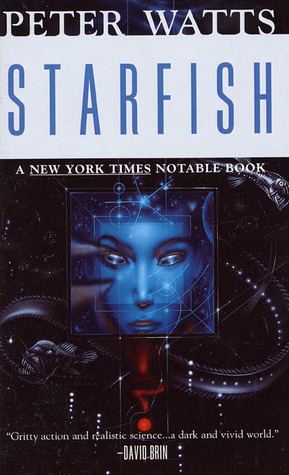
Starfish Novel Cover
Image

Book Review: Starfish by Peter Watts

If you like your sci-fi hard and your main characters psychologically disturbed, this is the book for you. Peter Watts takes a mission on the floor of the ocean and turns it into a crucible where some mad beings are formed. But, as Dickinson once said, much madness is divinest sense. The crazies aboard deep-sea station Beebe are smarter than their masters on the surface think they are, and they uncover a government plot with mistakes that would be comical if the circumstances weren’t so dire.

The first thing that struck me about this story is how detailed the science is. Peter Watts went through a lot of effort to recruit the help of scientists and military experts to get all the details as close to right as possible. Much of the science is speculative (and still is 14 years after the book was first published) but it’s all based on actual research and Watts is nice enough to include the names of the journals he referenced in the acknowledgments.

But what drives this story isn’t the science, nor the events, nor the odd setting of the bottom of the Pacific, where bioluminescent creatures roam with giant scary fish. The real engine of this story is the cast of characters, each with their own flavor of psychosis and history of abuse. The rigors of life on the deep-sea station Beebe would drive you mad, so it helps if you were already pretty crazy when you got there.

The first three quarters of the novel were riveting, but the ending leaves you hanging. That’s not a major issue since this is the first of a series, but if you like your stories to have endings with everything neatly tied up, or you don’t have the patience to read the whole series, the ending might disappoint. But if you’re looking for a different kind of sci-fi series with absolutely fascinating characters, Starfish is a good place to start.

Buy Starfish by Peter Watts on Amazon

Book Review: Redshirts by John Scalzi

Star Trek fans will immediately recognize the tropes this hilarious book lampoons. But Scalzi, who worked as a consultant on another sci-fi show, performs the clever trick of combining parody with homage to the genre that has inspired so many authors and readers even through plot holes, questionable scientific basis, and cliché.

It was a treat to uncover the very “meta” nature of this sci-fi universe that borrows heavily from a few space-faring military TV shows. It all starts out as standard spaceship fare, but around the middle of the book the plot takes a very odd turn and we learn that this universe isn’t as real as the characters thought it was. The characters are likable and they regularly provide the kind of punchy dialogue Scalzi is known for, and they go on a weird adventure that eventually leads them to confront their “creator” and take control of their own fates.

Just when I was thinking that humorous parody was all this book had to offer, the final chapters surprised me with a stark change in tone. The book shifts to examine how the events of the main plot affected some seemingly insignificant characters and the results are poignant, dramatic, and even a little somber. The book’s final chapters solidify the book’s central theme: the “throwaway” characters can have rich and touching stories of their own in the hands of a resourceful writer.

Buy Redshirts on Amazon at: http://www.amazon.com/dp/0765334798

The reality of guns, school security, and mental health

In the tragic aftermath of the Sandy Hook shooting, many Americans are questioning how we operate as a nation and whether our constitutional right to carry firearms needs more restraint, regulation, and thought. It is a long-overdue national conversation, and it will not be an easy one. But what this conversation needs most right now is perspective, and a clear view of the bigger picture.

Much of the debate in the most recent US news cycle is about the idea of putting armed guards in schools across the country. I find this unfolding debate very interesting, because to some degree I actually support this idea. But that is because I have a different viewpoint on the issue since I have lived a life most of you have not. I grew up in one of the most dangerous cities in the Western Hemisphere, and I know that armed security in our schools is a reality and has already been happening for years.

I have firsthand experience with growing up in a school system enveloped in tight security. I was born and raised in Detroit, where multilevel school security was the norm. During my high school years in the late 90s, the main student entrances had metal detectors. Side doors were chained shut (a violation of fire code, but deemed a necessity). The school had several unarmed security officers, and it was quite common to see a Detroit Police patrol car stationed in front of the building for most of the day. And this was in one of the nicer neighborhoods of the city.

Over the past decade, the security measures in Detroit have grown dramatically. Detroit now has a specialized police department solely for the city’s schools. You can see the Detroit Public Schools Police Department site here. But let me give you a quick taste of how serious things are over there:

The district’s Police Department, a deputized police force, includes 51 police officers patrolling schools 24-7. The district also has 47 Campus Police Officers at all high schools, and at other sites. And under a contract with Securitas, the district now provides security personnel in all K-8 schools, as well as additional security officers in all high schools.

The Detroit Public Schools also have a network of security cameras, a K-9 unit, and ID systems designed to match students to their schools and instantly match adult visitors against criminal databases including sex offender registries. It’s all part of a $41.7 million district-wide security initiative that strives to make all schools in the city safer. This is not the future, folks. This is now.

Is this the way things should be? No. Hell no. In an ideal world, our children would never have to worry about such things, and parents could send their kids to school with no concerns other than the quality of their child’s education. But Detroit had to take this direction. It wasn’t ideal, it wasn’t comfortable, and it damn sure wasn’t cheap. But, given the crime situation in the city, it was a necessary response to a sad reality.

Realism must often take precedence over idealism, but not always, and not forever. We can, and should, strive to change the status quo and build the kind of peaceful world we all want to live in. But there are certain realities that must be acknowledged and addressed right now while we work on that more ideal world of the future. That’s why I give some support to armed police (not private security) in schools. However, I also realize that this does not address the core problem.

But neither does a new gun law.

Both approaches are, at best, merely damage control. I support both, but have no illusions about either approach solving our ultimate problem.

The question that dominates the current conversation is, “How do we make things safe?” That’s a tough one, because the cruelest reality of all is this: We can never be 100% safe. The next line of questioning follows, “How do we make things safer?” And that’s an interesting one too because, despite how it feels, the facts show that violent crime in America is already plunging near record lows. Whatever we’re doing to make our nation safer is apparently already working. Incidents like Sandy Hook don’t necessarily show that our world is less safe, it just shows that the world is different. Like all things, crime changes; it adapts, it shifts. We must do the same.

Consider this: The National Instant Criminal Background Check System is used to check if someone can buy a gun from a federal registered dealer before they walk out of the shop with a shiny new firearm. As of the end of November 2012, there have been 16,808,538 applications. If they were all approved, that would be enough weapons to stock every member of NATO’s armed forces nearly five times over (and only 976,255 of those applications were denied). The system has received 156,577,260 applications since 1998. And this is just covering legal guns. Any proposed plan for reducing gun violence in the US will have to account for a stark reality: we are already inundated with millions of guns. Making them illegal won’t make them go away in a puff of smoke.

But even if we could somehow create a dramatic decrease in guns, there’s no proof it would prevent terrible acts like Sandy Hook. Look at what’s happening in China, for instance. The Chinese government imposes strict gun control rules, and citizens are not allowed to own personal firearms. Yet, since 2010 the country has seen a rash of school attacks with knives. Dozens of children have been killed or injured, and not a single shot was ever fired. Just hours before the Sandy Hook shooting, a man in the Henan province of China stabbed and slashed 23 children. There were no fatalities this time, but some of the children lost ears or fingers. Kids in previous attacks lost their lives.

If there had been an armed policeman at that Chinese school, maybe this wouldn’t have happened. But maybe it wouldn’t have mattered. Maybe China’s strict gun laws kept the incident from being even worse, but then the argument becomes a simple matter of degree in a topic where even one young life lost is too much. China will struggle with a solution to the problem just as America will. But there are some realities that are painfully clear here: this isn’t only an American problem, and it’s not limited to guns.

The events in America and China do share a common thread. There is a core, fundamental issue here that does not have an easy fix. The issue is mental health.

In China, there are no new gun laws to enact because guns clearly aren’t the problem. Instead, the recent school attacks have prompted calls for the government to address the long-standing national mental health issues that have become exacerbated by rapid social change. In America the conversation takes a slightly different direction. The argument is that we just shouldn’t let the mentally ill access guns, but there is little talk about giving them better treatment, or identifying them earlier, or analyzing the factors that made them mentally ill in the first place.

The connections are clear. The shooter in the Aurora Theater tragedy visited three separate psychologists before he dropped out of school. The shooter in the Virginia Tech massacre had a long history of documented mental health issues. And those who knew the Sandy Hook shooter said that they, sadly, were not surprised because he had “mental problems” for some time.

But the issue goes beyond public shooters. Estimates on the rate of mental illness in the homeless population of America range from 20% to 40%. The proportion of people with personality disorders is highest in the prison population, where many prisoners have been found to be suffering from some sort of personality disorder and at least 16 percent of the prison population can be classified as severely mentally ill. A lot of those people get released back on the streets after their sentences. Jeffrey Dahmer was arrested for disturbing sexually related crimes three times before we found out he was a serial killer.

Our inability to identify and help the mentally ill is a tragic failure of our social contract to keep everyone safe. These people are not evil, they’re not demons, and they don’t deserve to be ignored. They’re sick, they are mentally ill, and they need our compassion, and our help. And by helping them, we help ourselves. In the days to come, I do hope that we can see past the politics and focus on this issue that we have let fester for far too long. But I also know that the answers will not come easy, and they will not come fast, so I hope that we can devise reasonable and realistic measures to protect our most vulnerable citizens in the meantime.

Make your characters interesting; you’ll be with them for a while

Writing a novel is sometimes tedious, so it helps to have your characters become the most interesting people you know.

I’m going through the next-to-last editing phase of my book and it’s tough. It’s hard to find the focus to write after dealing with all the varied difficulties of life like work, friends, bills, and laundry (yes laundry, it’s easy to forget about it).

Then there’s the writer’s worse enemy: doubt. Doubt that all this effort is even worth anything. It’s easy to start questioning what you’re doing when you sit down and start thinking you’ve got more pressing matters to tend to. That doubt can kill all your creativity.

BUT, none of that matters if the world you are creating is a place you want to spend time in, and that place is filled with the most interesting people you can imagine. In those trying and tedious times spent at the desk, those characters become the best kinds of friends, and guides to fantastical adventures.